ICE Raids and the Fugitive Slave Acts

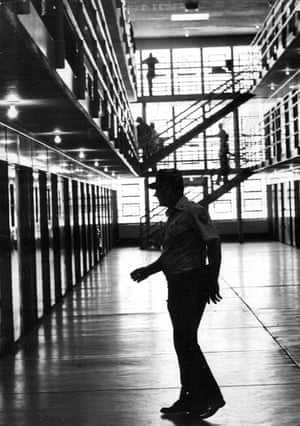
The ICE raids that we’re seeing today are not a new tactic. They bring to mind the Fugitive Slave Acts.

The Fugitive Slave Acts were a pair of federal laws that allowed for the capture and return of runaway enslaved people within certain states. The first act was enacted by Congress in 1793. The second act, which added more provisions and harsher punishments, was enacted in 1850 due to widespread resistance to the first act. 

The resistance to the Fugitive Slave Acts provides a historical model for defending Due Process rights in the present. 

Check out this video for more of my discussion on this topic with civil rights attorney Angela Groves.

Systemic Problems Require Systemic Solutions

The backlash we’ve experienced between 2020 and 2025 shows us that systemic problems require systemic solutions. While we saw the beginning of some measures of progress in the aftermath of the killing of George Floyd, we did not get new federal legislation addressing racial injustices. 

This means we still need to fight for the progress we want to see. 

Check out this video for more of my discussion on this topic with civil rights attorney Angela Groves.

Voters Showed Us That DEI Still Matters 

Last week, voters turned out to the polls for several important elections. The results suggest that diversity, equity, and inclusion still matter to many voters. 

There were several historic firsts as a result of last week’s elections, including: 

  • Zohran Mamdani, born in Uganda to parents of Indian descent, will be the first Muslim mayor of New York City. 
  • Abigail Spanberger will be the first woman to serve as governor of Virginia. 
  • Mary Sheffied will be the first woman to serve as mayor of Detroit. 
  • Ghazala Hashmi became the first Muslim woman elected to statewide office. 
  • Kaohly Her will be the first Hmong person to serve as mayor of St. Paul, Minnesota.

True democracy is diverse, equitable, and inclusive. These historic wins demonstrate the power of our vote and the potential of our democracy. 

To learn more about the newly elected officials named above, check out this article from the New York Times. 

Defending democracy is 24/7/365

Make Your Voting Plan Today

Election Day is Tuesday, November 4th! If you haven’t done so already, now is the time to make your voting plan. 

Every voter should have a plan before casting their ballot. Here are five steps you can take to make your voting plan: 

  1. Confirm your voter registration status. Some states, such as Virginia, allow you to register in person on Election Day or during early voting. You can check your registration status using this tool (https://www.vote411.org/check-registration).
  1. Research your early voting options. You can use this tool (https://www.vote411.org/search-by-topic) to find more information about early voting in your state (select your state and the topic “early voting”).
  1. Learn your options for voting in person on Election Day. Know in advance where you can vote in person and what to bring with you. This tool (https://www.vote411.org/) can help.
  1. If you are voting in person, decide how and when you will get to the polls. 
  1. Get to know more about the candidates and issues on your ballot. My blog post on researching candidates has tips on how to prepare.

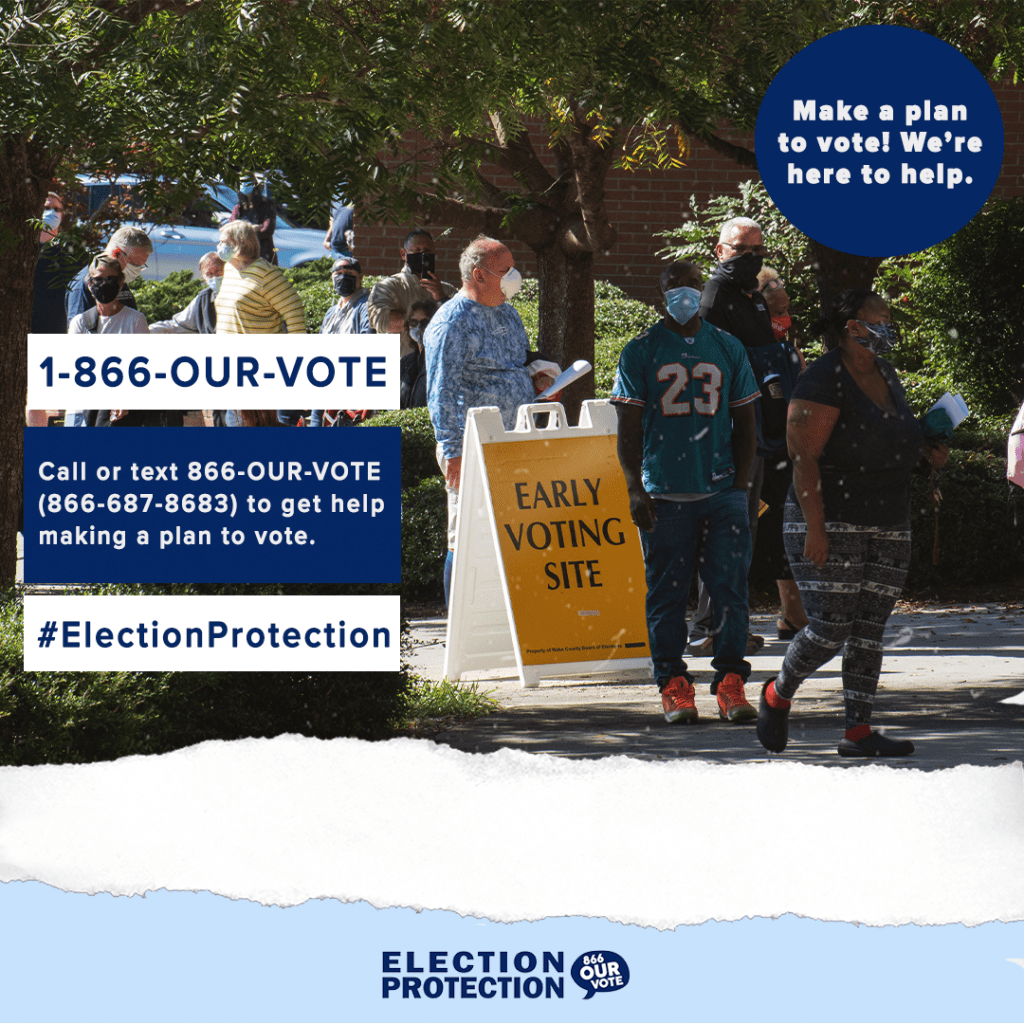
If you need additional help creating your voting plan, you can call 1-866-OUR-VOTE for nonpartisan support. Make your voting plan now and be prepared to exercise your right to vote in this election!

Defending Democracy is 24/7/365

Educate Yourself Before You Vote: How to Research Your Ballot

Graphic by Fair Fight Action

Election Day (Tuesday, November 4th) is around the corner! It is critical to educate yourself before casting your ballot. Below are some steps you can take to make sure you are an informed voter. 

  1. Find out what will be on your ballot. Many local election offices mail sample ballots to voters. If you do not receive a sample ballot in the mail, check your state’s election office website or visit your local election office in-person. 
  2. Research the candidates on your ballot. Each of the sources below may provide useful information about the candidates.
    • Candidate websites and campaign materials provide their firsthand account of candidate positions and qualifications. 
    • Endorsements can provide information about a candidate’s values and priorities. 
    • Past voting records reveal the stances a candidate has taken in the past. 
    • Debates and town halls allow you to hear directly from multiple candidates on important issues in the election. 
    • Voter guides can be informational or political depending on the author. You can find organizations that align with your values and use their voting guides as a reference for determining your vote. 
  3. Fact check ads and social media content to ensure that the information you are using is accurate. 

Learn more about how to research your ballot at the link below: https://www.rockthevote.org/explainers/how-to-research-your-ballot/

Stay informed and get out to vote on November 4th!

Louisiana v. Callais Argument

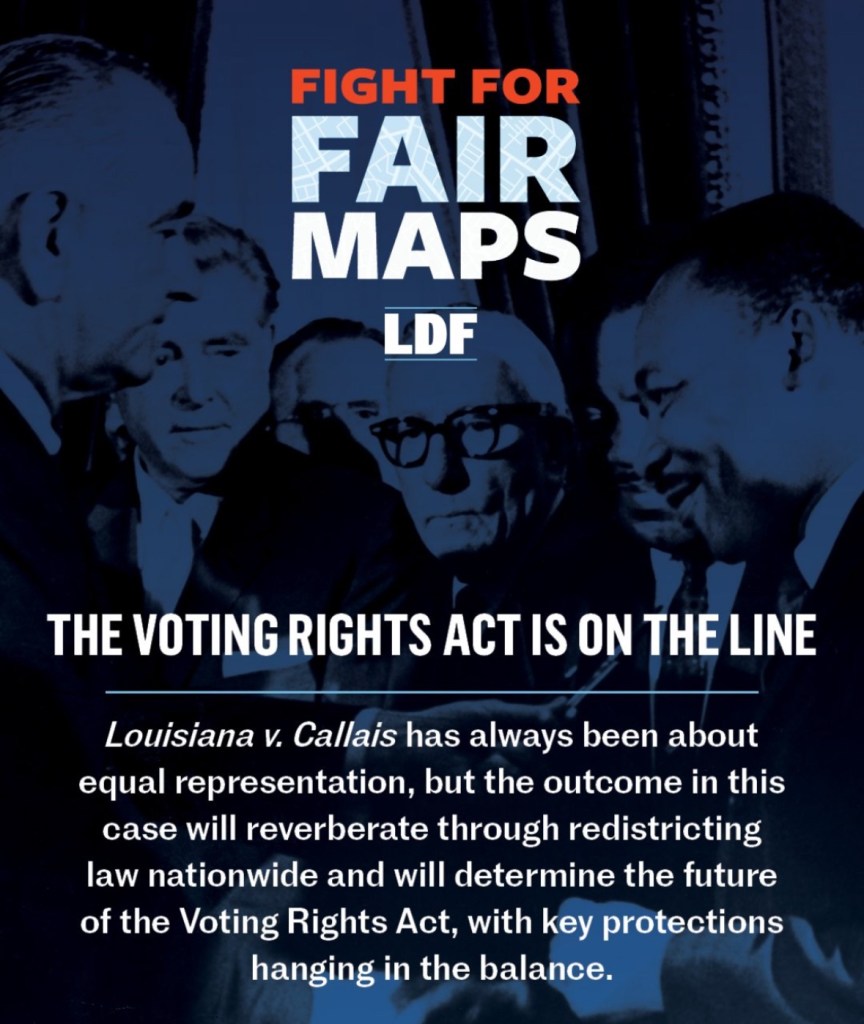
Today, the U.S. Supreme Court heard arguments in Louisiana v. Callais. This is an important case for voting rights and I encourage you to closely monitor its outcome. 

The case is about equal representation for Black voters and the role of race in the redistricting process. However, key protections of the Voting Rights Acts (VRA) are on the line due to supplemental questions posed by the Court regarding the constitutionality of the application of the VRA in redistricting. 

Check out this explainer from LDF to further inform yourself about this important case. We must defend our voting rights!

From 2020 to 2025 (Part 1)

Between 2020 and 2025, we saw a period of progress followed by a swift rollback. In reflecting on this change, I must remind us of the period of Reconstruction. 

During Reconstruction, Black Americans experienced eight years of freedom, building businesses and communities, even becoming elected officials. After only eight years, these freedoms were taken away. 

In the aftermath of the horrific killing of George Floyd, we entered into a similar period where it seemed as if we were making great progress. America was seeing itself and didn’t like what it saw. However, the country seemed to decide that it would only go so far. We did not get nearly enough systemic change, especially at the federal level. 

All this means we still have to be engaged and ready to do the work of reconstructing the country we want to live in. 

See an excerpt of my conversation on this topic with civil rights attorney Angela Groves in this video

*Defending democracy is 24/7/365 

Advice to Law Students: Know Your Why

The new academic year is now in full swing. As a law professor, I am often asked if I have advice for incoming law students. 

First, even with the new challenges in education, I still believe in the value of education and in the value of a law degree. 

Second, I tell my students that you have to know why you’re here. Remember why you wanted to become a lawyer as you prepare to make sacrifices to reach your goal. 

Check out this video for my conversation on this topic with civil rights attorney Angela Groves. Share this message with an incoming law student (and remember to support them along their journey)!

Announcing the ‘In Good Faith’ Newsletter

I am excited to announce my latest Substack newsletter, “In Good Faith”. I am co-authoring this Substack with political strategist and civil rights attorney Leslie Gross. You can subscribe and learn more here.

In Good Faith is a democracy-focused Substack that goes behind the headlines to explore the legal principles and broken promises shaping our civic life.

Every week, In Good Faith will spotlight one clear example of when power breaks its promise—whether it’s a violation of the Constitution, an abuse of public trust, or a failure of basic ethical leadership.

Each post will:

  • Explain what happened and why it matters
  • Show how it should have worked under law and principle
  • Offer practical ways you can respond, share, and help rebuild trust
  • Include a short 2–3 minute video conversation unpacking the issue

We’re creating more than a newsletter. In Good Faith is a community of people—professionals, parents, voters, and leaders—who still believe democracy can work when we hold it accountable. It’s a space for honest conversation, principled debate, and shared tools for defending the rule of law.

Together, we’ll model the very values we want to see in our leaders: openness, cooperation, consistency, and respect for the dignity of every person.

Because promises to the people are sacred.

Public Media and Democracy

Last week, Congress clawed back $1.1 billion in funding that had previously been allocated to the Corporation for Public Broadcasting.

Public media sources like NPR and PBS help people stay informed about what’s happening in their communities and government. I regularly encourage people to educate, litigate, legislate, and participate to create social change. Trustworthy public media sources support the first prong – educate – by providing a way for all of us to stay informed about important developments that affect our lives. 

A thriving democracy requires a well-informed public and strong civic engagement. Cuts to quality public media are strikes against our democracy. 

To learn more about the recent cuts to public media, review this report from NPR: https://www.npr.org/2025/07/18/nx-s1-5469912/npr-congress-rescission-funding-trump 

John Lewis National Day of Action 

Source: Britannica

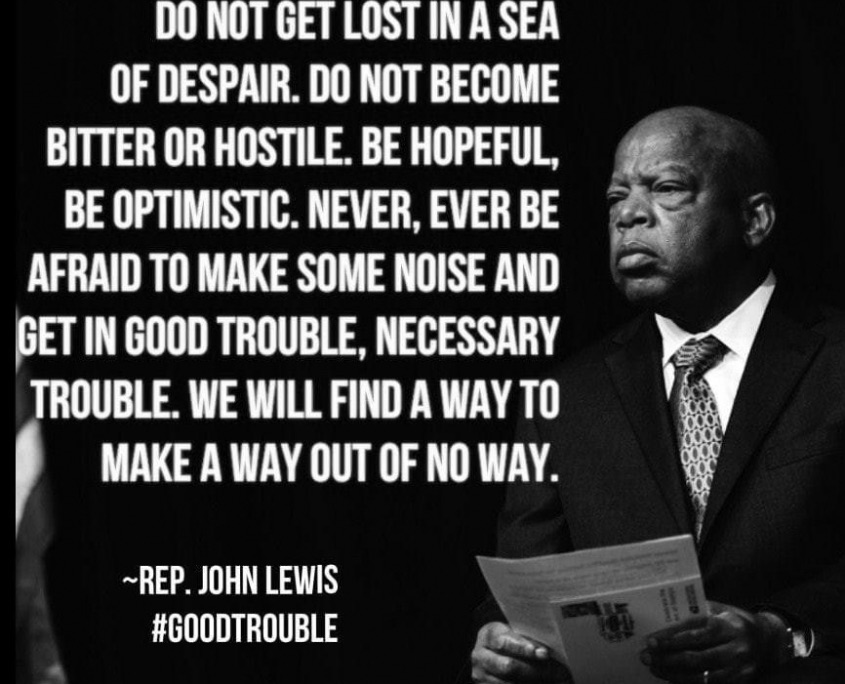
Today is the John Lewis National Day of Action. Congressman John Lewis passed away five years ago on July 17th, leaving a remarkable legacy of civil and human rights advocacy.  

Congressman Lewis was a leading advocate for voting rights and the John Lewis Voting Rights Advancement Act (VRAA) was named in his honor. The VRAA, which is yet to be passed by Congress, would strengthen legal protections of our voting rights. Given the ongoing attacks against these rights, the VRAA is as needed as ever.  

Specifically, the VRAA would update the preclearance program that was gutted by the Supreme Court in Shelby County v. Holder (2013). The VRAA preclearance framework would require jurisdictions with a history of voting discrimination to get prior approval before implementing electoral changes. The VRAA would also strengthen Section 2 of the Voting Rights Act of 1965, which allows voters to sue to block discriminatory voting laws.   

To learn more about the VRAA, read this fact sheet by the Brennan Center for Justice: https://www.brennancenter.org/our-work/research-reports/john-r-lewis-voting-rights-advancement-act

To find a John Lewis National Day of Action event near you, check out this resource from Good Trouble Lives On: https://goodtroubleliveson.org/#attend

Defending democracy is 24/7/365 

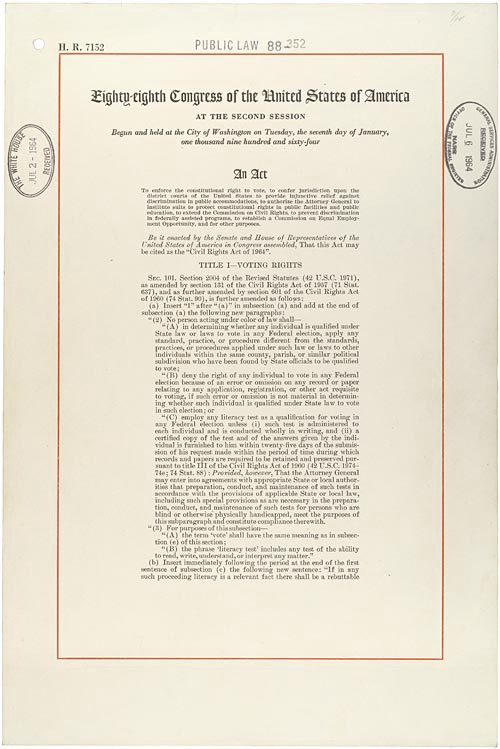
Commemorating the 61st Anniversary of the Civil Rights Act of 1964

Last week marked the 61st anniversary of the Civil Rights Act of 1965 (“CRA”). The CRA was signed into law by President Lyndon B. Johnson on July 2, 2024. This landmark civil rights legislation was passed as a result of coordinated organizing, litigation, protests, and other social movement strategies. 

The CRA prohibits discrimination on the basis of race, color, religion, sex, or national origin in public places and employment. The CRA also declared the integration of public accommodations and schools. Here are three resources you can consult to learn about more the CRA:

  1. Legal Defense Fund, 2024 Statement on the CRA: https://www.naacpldf.org/press-release/ldf-reflects-on-60th-anniversary-of-the-civil-rights-act-of-1964/ 
  2. National Archives, Milestone Documents: https://www.archives.gov/milestone-documents/civil-rights-act 
  3. American Bar Association, 2024 Webinar Series on Preserving the Integrity of the CRA: https://www.americanbar.org/groups/diversity/resources/civil-rights-act-1964-program/ 

Today, the protections provided by the CRA are under attack as much as ever. We can commemorate the anniversary of the CRA by defending the principles it championed and fighting for the further expansion of our civil rights. 

What to the Slave is the Fourth of July?

National Archives and Records Administration

As the Fourth of July holiday approaches, I am reminded of Frederick Douglass’ powerful 1852 address. I encourage you to join me in reflecting on his speech this weekend, an excerpt of which is included below: 

“I say it with a sad sense of the disparity between us. I am not included within the pale of glorious anniversary! Your high independence only reveals the immeasurable distance between us. The blessings in which you, this day, rejoice, are not enjoyed in common. The rich inheritance of justice, liberty, prosperity and independence, bequeathed by your fathers, is shared by you, not by me. The sunlight that brought light and healing to you, has brought stripes and death to me. This Fourth July is yours, not mine. You may rejoice, I must mourn.”

To learn more about Douglass’ speech and watch his descendants recite the speech in 2020, check out this resource from the National Museum of African American History and Culture: https://nmaahc.si.edu/explore/stories/nations-story-what-slave-fourth-july

Calling Out the Dismantling of the DOJ Civil Rights Division 

Last week, the Leadership Conference on Civil and Human Rights, along with 85 national civil rights organizations, submitted a powerful letter calling on congressional leaders to exercise their oversight responsibility over the U.S. Department of Justice’s Civil Rights Division. The letter is worth a read. 

In the letter, the Leadership Conference outlines the unprecedented dismantling of the Civil Rights Division under the current administration. It explains how the mission of the Division, which has historically played an important role in advancing civil rights, has been abandoned. It also sounds the alarm on the significant loss of civil rights expertise within the Division, estimating that the attorney staff has been reduced by about 70%. Even more, the Division has withdrawn from litigating important pending civil rights cases. 

We must stay educated about these troubling developments and do our part to speak out. 

Defending democracy is 24/7/365

Resist and Persist

Understandably, many are in a moment of reset. Do not mistake a reset for a surrender. 

In this moment, I’ve been encouraging people to resist and persist. You can resist the attacks on our rights wherever you are. For some, such as law students, their resistance is being exceptional law students. For others, it’s going to work every day and taking care of their families. 

Wherever you are, you have a role to play. Rest, but don’t quit. 

Check out the video on my LinkedIn page for more of my discussion on this topic.

Defending democracy is 24/7/365. 

Looking Inward to Remain Hopeful

We are in a moment where it is important to fight against feelings of hopelessness. In addition to the external actions that I’ve discussed on my platforms, there are also steps we can take by looking inward. 

Three inward-facing actions that I have been sharing with my community are:

  1. Leaning into your faith, family, and community. 
  2. Shoring up your economic capacity so that you can sustain yourself and help others. 
  3. Staying engaged at the local level. 

Check out this video for more of my discussion on this topic. 

Defending democracy is 24/7/365. 

The Cycles of Voter Suppression (Part 2)

My research identifies three cycles of voter suppression. Each cycle has lasted about 100 years. We are about 60 years into the current cycle, which began with the passage of the Voting Right Act. 

Currently, we are seeing a roll back of rights on every hand. It’s going to take the same types of efforts that were used to overcome prior cycles of voter suppression to end the current cycle. That includes the four pillars that I frequently discuss: educating, legislating, litigating, and participating. 

Those of us who operate in democracy will need to mobilize, organize, and realize our power as a collective people to ensure that we don’t lose ground and can keep moving forward. 

I encourage you to read my full article on this topic, “Ending the Cycles of Voter Suppression” published by the Harvard Civil Rights-Civil Liberties Law Review. It is available here: https://journals.law.harvard.edu/crcl/wp-content/uploads/sites/80/2025/03/10_HLC_60_1_Daniels.pdf. You can also check out my video below. 

Defending democracy is 24/7/365. 

The Cycles of Voter Suppression (Part 1)

I recently published an article in the Harvard Civil Rights-Civil Liberties Law Review titled, “Ending the Cycles of Voter Suppression”. I encourage you to read the full article here.

My article explains three cycles of voter suppression. The first cycle began with the founding of our county. At this time, enslaved Africans were counted as three-fifths of a whole person. From our beginnings as a country, there was a distinction between who would receive the full benefits of citizenship and who would not. This first cycle lasted for about 100 years and ended with the Reconstruction Amendments (the 13th, 14th, and 15th Amendments). 

During the second cycle, the Reconstruction Amendments were ratified, but then states also passed literacy tests, grandfather clauses, poll taxes, and other disenfranchising mechanisms. These mechanisms essentially eliminated the advances of the Reconstruction Amendments. 

The third cycle began with the passage of the Voting Rights Act, which was passed following Bloody Sunday. The passage of the VRA was and continues to be followed by decades of increasingly aggressive efforts to dismantle it. We are about 60 years into this current cycle. 

Check out the video below where I discuss the cycles of voter suppression with civil rights attorney Angela Groves. 

Figuring Out Where to Start? Work on the Issue that Bothers You the Most

With so much going on in the news, it can be challenging to figure out where to start or what to focus on. My advice is to start with the issue that bothers you the most. 

Then, whether your issue is immigration, education, or criminal justice reform, there is an organization that’s been working on that particular issue. Do your research to find the organizations in your community that are doing the work and join them. You do not need to start from scratch. 

Over time, hopefully, you will see that you are starting to make a difference and seeing changes in those areas. 

Check out my conversation on this topic with civil rights attorney Angela Groves in the video below. 

Defending democracy is 24/7/365. 

If You’re Ending Your DEI Programming Now, You Were Never Truly Committed

Across the country, educational institutions, corporations, and even law firms have been ending or scaling back their DEI programs. Often, the explanation given is that they want to comply with threats from the White House or SFFA v. Harvard. However, as I’ve said many times before, DEI is not illegal. 

Institutions ending their DEI programs are demonstrating that they were never truly committed to DEI in the first place. Most of these programs were established after the George Floyd uprisings and have not even been in place for 10 years. To see institutions turning from their DEI programs so quickly is disheartening. 

However, now the power is our hands. We can stand up and say that if an institution does not support DEI, then it does not deserve our support. 

Check out my conversation on this topic with civil rights attorney Angela Groves in the video below. 

Defending democracy is 24/7/365. 

Understanding Recent Attacks on Law Firms and Lawyers

Over the past couple months, we have seen attacks on the law firms, attorneys, and judges. It is important to understand that what we’re witnessing is an attack on systems. Across the board, in fact, we are seeing concerted attacks on systems. 

An attempt by the executive branch to control who law firms or lawyers can represent is an attempt to control the entire legal system. If you can get rid of the legal system, you can eliminate an essential avenue for resistance.

With our systems under attack, it is up to us to do our part to fight back. Check out my conversation on this topic with civil rights attorney Angela Groves in the video below. 

Defending democracy is 24/7/365.

Educate, Legislate, Litigate, Participate

With all of the recent attacks on our civil rights, I am often asked what the current moment demands of us. My answer is the same as it was before the election: educate, legislate, litigate, participate. 

  1. Educate: We must educate ourselves about what is happening and how it is impacting our communities. 
  2. Legislate: Contact your elected officials. You are a part of their constituency, regardless of whether or not you voted for them. Find out your representative’s phone number and let them know how you feel about proposed legislation. 
  3. Litigate: Lawsuits are an important tool. We need to help the civil rights organizations that are fighting for our rights in court. 
  4. Participate: Join the local organizations that are working in your interest. We need you to help fight against the dismantling of our rights. 

Check out my conversation on this topic with fellow civil rights attorney Angela Groves in the video below. 

Defending democracy is 24/7/365. 

Ending the Cycles of Voter Suppression

Last month, I published an article in the Harvard Civil Rights-Civil Liberties Law Review titled, “Ending the Cycles of Voter Suppression”. In the article, I provide a brief history of voter suppression and propose measures that can lead us to dismantle it once and for all. I encourage you to read the full article here.

My article explains that our country has repeatedly endured cycles of voter suppression that involve periods of progress followed by the implementation of regressive laws. Our cycles of voter suppression tend to last approximately a hundred years: consider from the founding of our nation to the ratification of the Fifteenth Amendment (94 years), or from the passage of the Fifteenth Amendment to the passage of the Voting Rights Act (VRA) (95 years). The end of each cycle occurred with the passage of impactful legislation that massively added to the electorate. 

In 2025, we are sixty years into another cycle of voter suppression—a cycle that began with passage of the VRA, followed by decades of increasingly aggressive efforts to dismantle it. However, all hope is not lost. Defending and maintaining democracy requires a multi-faceted approach.

As I explain in the article, even though courts continue to serve as an option for relief, they have also demonstrated numerous times in this century that they are not a viable solution due to their anti-democratic and anti-voter decisions.

Instead, I argue that in order to end voter suppression once and for all, Congress must restore the VRA’s principles of notice, transparency, and fairness, while also adapting it to address modern challenges. Enshrining an affirmative right to vote in the Constitution can help lead the way in expanding access to the ballot and ensuring every eligible citizen can vote freely. States must also step in to protect voting rights through state-level voting protections. Finally, we must revitalize civic education and promote civic engagement through grassroots organizations because the power of people has always been key to shaping this nation into a truly democratic country. 

As we work toward ending voter suppression, we must not forget that “democracy delayed is democracy denied.” 

Defending democracy is 24/7/365. 
The Living Constitution: A DEI Document (Part 2)

Last month, I shared Part 1 of my recent presentation about living Constitutionalism. I promised to return with Part 2. 

The U.S. Constitution is a DEI document. We need to look no further than the Reconstruction Amendments – the Thirteenth, Fourteenth, and Fifteenth Amendments – to see this.

The Thirteenth Amendment, passed in 1865, outlawed slavery (except as punishment for crime). The Fourteenth Amendment, passed in 1866 and ratified in 1868, extended the liberties and rights granted by the Bill of Rights to formerly enslaved people. The Fifteenth Amendment, passed in 1869 and ratified in 1870, extended the right to vote to Black men. We can also look to the Nineteenth Amendment, which finally granted women the right to vote in 1920. 

Each of these amendments made our living Constitution more inclusive. They extended constitutional protections to those who had previously been excluded. In the midst of targeted attacks against DEI, our very own Constitution demonstrates why so-called “DEI documents” are essential to achieving the promise of democracy in America. 

It is up to us to fight for their survival. 

Defending democracy is 24/7/365.

The Living Constitution (Part 1)

This Photo by Unknown Author is licensed under CC BY-SA-NC

Earlier this week, I gave a presentation on Living Constitutionalism. At the suggestion of one of my law students, I am sharing some of that presentation with you all.  

Living Constitutionalism proposes that interpretations of the U.S. Constitution should evolve with societal changes, adapting to new circumstances without requiring formal amendments. This approach ensures that constitutional rights remain relevant and effective in addressing the challenges of a rapidly changing world. Ideals such as “liberty” and “equal protection” are embedded in the Constitution because they are timeless and inherently adaptable, designed to evolve with society.

Living Constitutionalism is crucial for addressing contemporary challenges such as digital privacy, LGBTQ+ rights, and racial equality. These issues require a nuanced application of age-old principles to new contexts.​

Living Constitutionalism respects established legal precedents while facilitating interpretations that reflect current ethical and moral standards, thereby promoting progressive societal change.

This understanding of our Constitution is as necessary now as ever. 

Be on the lookout for Part 2 of this blog post, explaining why our living Constitution is a DEI document. 

Defending Democracy is 24/7/365.

Lessons from Reconstruction: Free At Last, Not So Fast

This Black History Month, I want to elaborate on a theme that I write about in my book, Uncounted: The Crisis of Voter Suppression in America. That theme is,  “Free at last, not so fast”. 

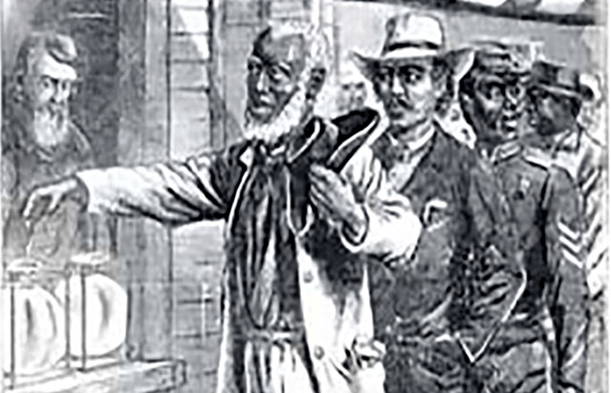
After the passage of the 13th, 14th, and 15th Amendments, Black men were able to register and vote, and indeed they did. Out of slavery, they were able to elect more than 2,000 Black men to office, from U.S. Senators to judges. With a focus on voting and education, they also created school boards. 

The freedom of Reconstruction was short-lived. White landowners in power wanted to stay in power. Just as the law was used to give formerly enslaved people freedom, it was also used to take it away. 

This historical pattern of progress and backlash is not new. “Free at last, not so fast” is a reminder that we have to fight to keep the freedoms that we have. 

Check out the video below for the full discussion with my colleague Angela Groves. 

Defending democracy is 24/7/365. 

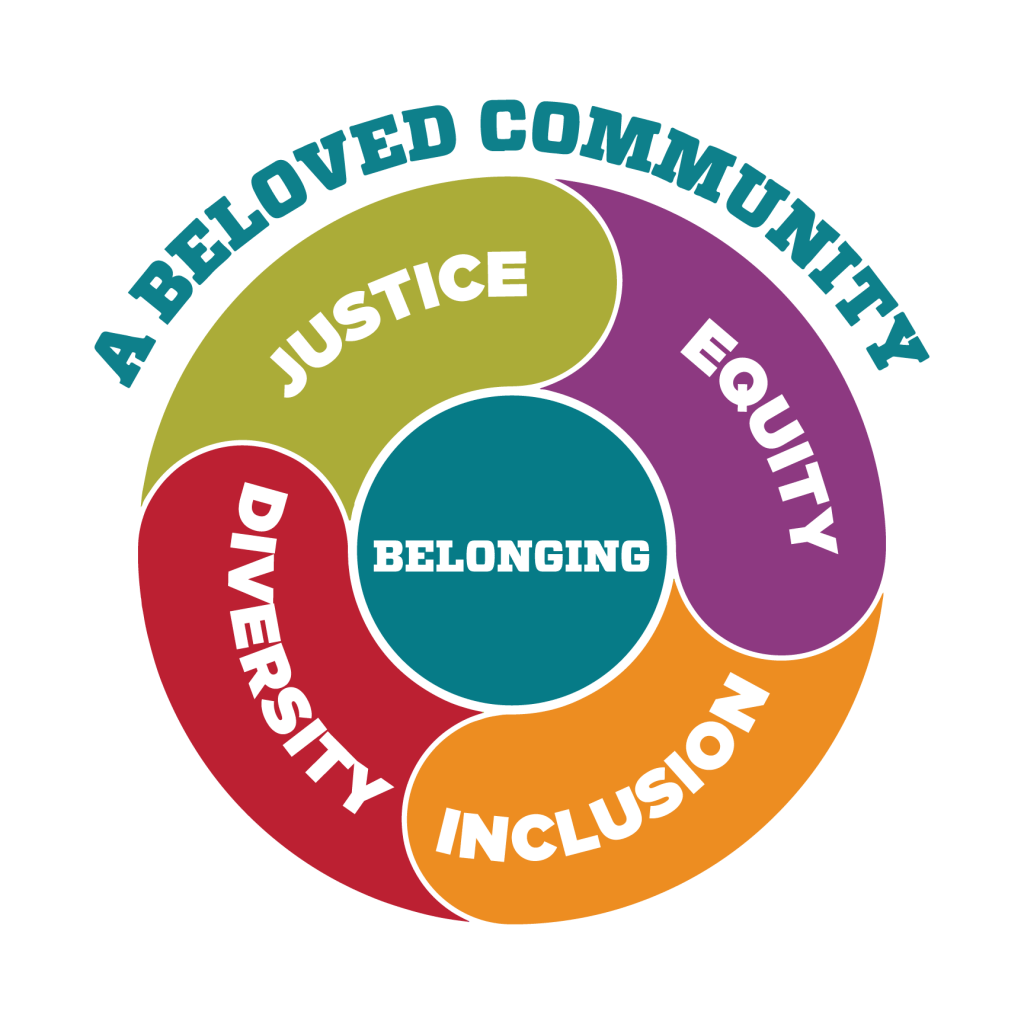
What Is DEI?

Image source: https://hsc.unm.edu/medicine/diversity/

The mounting attacks against diversity, equity, and inclusion (“DEI”) have relied on distortions of the meaning of DEI. It’s important that civil rights advocates set the record straight. 

As ReNika Moore of the ACLU explains, programs labeled as DEI “encompass a broad range of lawful initiatives that create fairer workplaces and schools.” DEI initiatives aim to ensure that opportunities aren’t limited based on race, ethnicity, disability, sex, sexual orientation, or gender identity. Examples of DEI initiatives include everything from fair hiring processes to corporate sponsorships to employee-led affinity groups, among others. 

Contrary to the misconstruction that DEI is somehow discriminatory, DEI initiatives were created to counter systemic discrimination and eliminate barriers that never should have existed in the first place. DEI policies allow companies and workplaces to comply with anti-discrimination laws that have been on the books for decades. 

Here are three reliable resources that you can use to build your own understanding of DEI initiatives and the recent attacks against DEI:

  1. ACLU explainer of DEI and Trump’s anti-DEI Executive Orders: https://www.aclu.org/news/racial-justice/trumps-executive-orders-rolling-back-dei-and-accessibility-efforts-explained
  2. The Guardian explainer of DEI, DEI rollbacks, and global implications of rollbacks: https://www.theguardian.com/us-news/2025/jan/24/diversity-backlash-what-is-dei-and-why-is-trump-opposed-to-it 
  3. Pew Research Center 2023 study finding that majority of U.S. workers say DEI at work is a good thing: https://www.pewresearch.org/social-trends/2023/05/17/diversity-equity-and-inclusion-in-the-workplace/ 

Defending democracy is 24/7/365. 

DEI Is Not Illegal

In the past couple weeks, we have seen an escalation of attacks against “DEI”, or diversity, equity, and inclusion. These attacks have been fueled, in part, by misinformation about the meaning and value of DEI. In my upcoming posts, I will be sharing resources with accurate information about what DEI is. 

But let me begin with what DEI is not. DEI is not illegal. Workplaces, schools, governmental bodies, and other institutions can comply with the Constitution while also implementing policies, practices, and offices that explicitly support diversity, equity, and inclusion. In fact, the Constitution itself is a DEI document. The Reconstruction Amendments, in particular, expanded the civil protections of our Constitution to marginalized groups in order to make this country more equitable and more inclusive.

Diversity, equity, and inclusion are not bad words or bad acts. Racism is the bad word and the bad act. Let’s be clear about this. 

Defending democracy is 24/7/365. 

MLK Day + Inauguration Day 2025

Today is both Martin Luther King Jr. Day and Inauguration Day, beginning Trump’s second term as President. This overlap brings to mind a theme in the history of American voting rights that I refer to as, “Free at Last. Not so Fast.” 

If nothing else, this moment calls on us to pay attention and continue to fight. Our freedoms are not guaranteed. They were bought at a price and there is still a price to be paid. That price is hard work. We’re going to have to continue to do the work to keep our freedoms. 

Check out my full conversation with my colleague Angela Groves in the video below. 

Defending democracy is 24/7/365. 

What Happened on Election Day?

What happened on Election Day last November? Democracy worked, in that people were able to voice their opinions through the vote. 

By and large, those who wanted to cast a ballot had the opportunity to do so. Many lawsuits were filed in advance of the election to create an environment in which people could participate freely, fairly, and without discrimination. While we may not like the outcome, the sobering reality is that those who wanted to make their voices heard at the ballot box were able to do so.

Low voter turnout (about 64% for the presidential election), however, is something that must be addressed. Many of those who did not vote were taken advantage of by misinformation and disinformation. A lot of content on social media was targeted towards influencing people not to vote. 

As we press forward, we have to keep showing people that their vote matters and that they should have a say in which candidates are elected.  

Check out my full conversation on this topic in the video below.

Defending democracy is 24/7/365. 

New Year’s Resolutions for Voters

Happy New Year! Many of us make New Year’s Resolutions for our personal and professional lives. What if we were to make a set of New Year’s resolutions focused on our roles as voters? 

Take a look at the video below as I discuss four New Year’s Resolutions for Voters with my colleague Angela Groves: “Educate. Legislate. Litigate. Participate.” 

Defending democracy is 24/7/365. 
View this blog post and join my email list at: https://civilrightstoday.org

Amplifying Our Wins

As we begin winding down for the holiday season, I have been reflecting on the voting rights victories of the November election. There is much to say of the losses, but we cannot lose sight of our wins. 

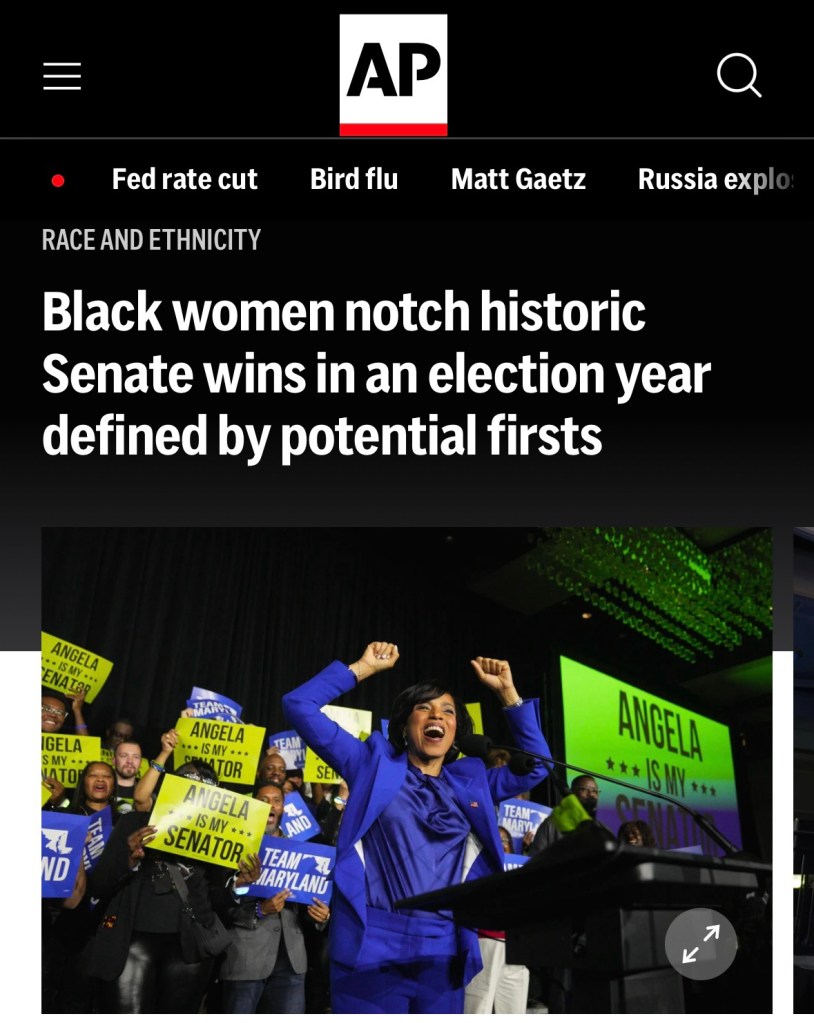
For example, for the first time in our nation’s nearly 250-year history, two Black women will serve in the Senate at the same time. These women are Angela Alsobrooks of Maryland and Lisa Blunt Rochester of Delaware. 

After tireless organizing and litigation, Alabama voters elected Shomari Figures to represent the congressional district that Alabama was ordered by the Supreme Court to redraw. Figures will be the first Black person to represent this district since 1832. And for the first time in history, Alabama will have two Black members serving in Congress at the same time.

In Louisiana, redrawn congressional maps made way for increased representation for Black voters. Louisiana voters elected Cleo Fields to represent this redrawn district. 

These victories were hard fought. As we press forward and contend with the new political realities resulting from the November election, let’s not overlook the places where progress was made. 

Defending Democracy is 24/7/365. Join my email list at https://civilrightstoday.org/about/.

It’s Time to Activate Our Checks and Balances

This week, I’ve been posting on social media about the checks and balances built into our democracy. 

We have every reason to believe that the coming years will test the limits of our system’s checks and balances. But, as constitutional law professors have observed, our existing guardrails can be powerful tools for defending democracy. These checks and balances are designed to protect us from autocratic control. 

One check that we have seen emerge in the past week is the power of state governments. The California Attorney General, for example, is already preparing to “use every tool” to defend constitutional rights. Litigation in coordination with other states is a tool that California is preparing.

Another check comes from civil society. Nonprofit organizations, for example, showed up in significant ways during the last Trump administration and are gearing up to do so again. 

Our work in the coming months and years must include exploring and activating existing checks and balances in defense of our communities. 

Defending democracy is 24/7/365. 
The Work Starts Now

The General Election may be over, but our work starts now. We can create the democracy that we want to live in. We do that by showing up in our communities and fighting back against injustice at every turn. No matter the challenges ahead, we must demand that democracy remains. 

As I often say, defending democracy is 24/7/365. This has never been more true.
Now, let’s get to work! 

Do You Know Your Voting Plan? 

The General Election is just five days away! If you haven’t done so already, now is the time to make your voting plan. 

Every voter should have a plan before casting their ballot. Here are five steps you can take to make your voting plan: 

  1. Confirm your voter registration status. Some states, such as Virginia and the District of Columbia, allow you to register in person on Election Day or during early voting. You can check your registration status using this tool
  1. Research your early voting options. My prior blog post on early voting includes helpful early voting resources. 
  1. Learn your options for voting in person on Election Day. Know in advance where you can vote in person and what to bring with you. This site can help.
  1. If you are voting in person, decide how and when you will get to the polls. Many organizations offer free or discounted rides to vote. For example, Lyft is offering half off rides to the polls on Election Day.  
  1. Get to know more about the candidates and issues on your ballot. It is critical to vote for all offices and issues on your ballot. My prior blog post on down-ballot voting has tips on how to prepare.

If you need additional help creating your voting plan, you can call 1-866-OUR-VOTE for nonpartisan support.

Defending Democracy is 24/7/365

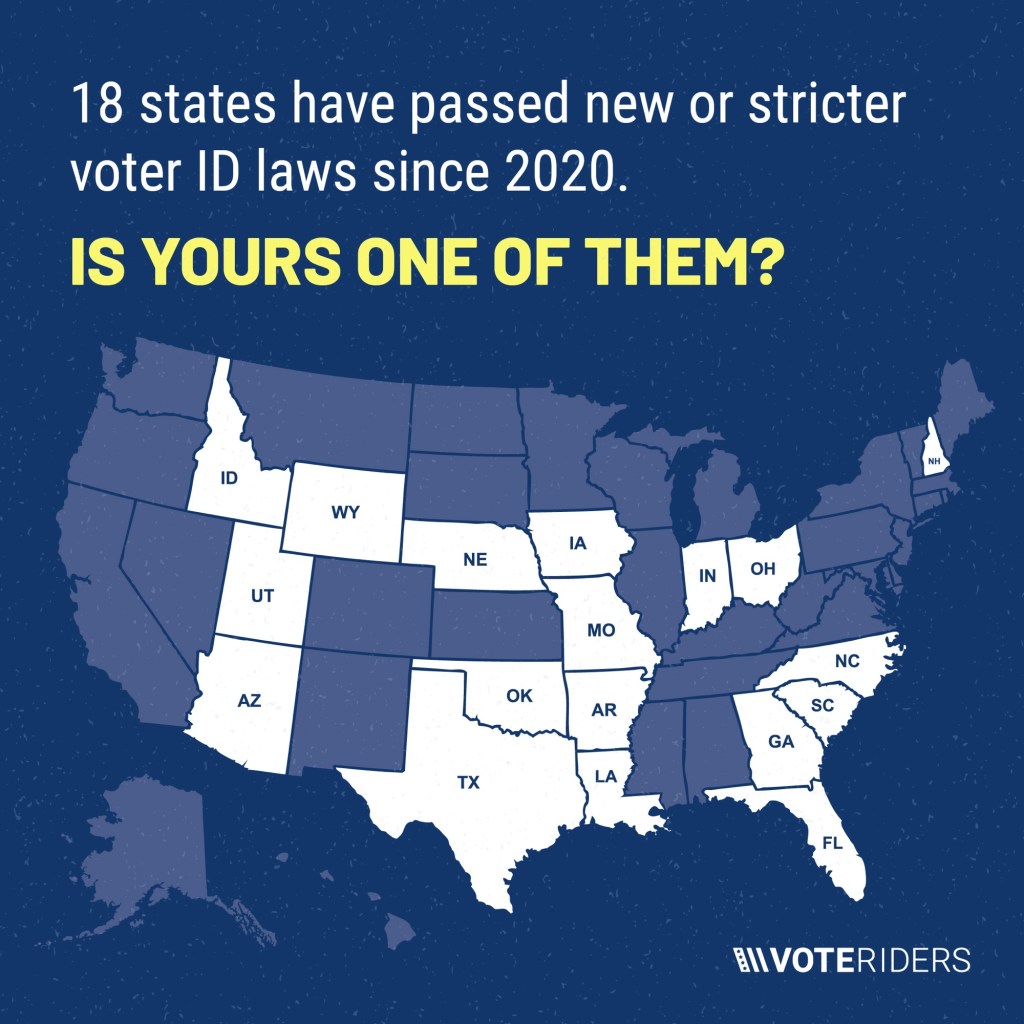
Know Before You Go: Voter ID Requirements

It is important to prepare to vote before you cast your ballot. Part of this preparation should include educating yourself and your loved ones about the voter ID requirements, if any, in your state. 

Voter ID requirements vary by state. Some jurisdictions, like the District of Columbia, do not require most voters to present identification in order to vote. However, others, such as Alabama, require a photo ID for all voters. It is always best to confirm the voter ID requirements in your state by checking your local board of elections website. You can also use the tools provided by Vote.Org (https://www.vote.org/voter-id-laws/) or Ballotpedia (https://ballotpedia.org/Voter_identification_laws_by_state). 

In addition to educating yourself, join organizing efforts to expand access to voting! Strict voter ID laws are a modern voter suppression tactic, presenting barriers to voting that disproportionately harm Black and Brown voters. Let’s organize and litigate against these tactics, while also preparing voters to meet the existing requirements in their states for the upcoming election. 

Defending democracy is 365/24/7. 

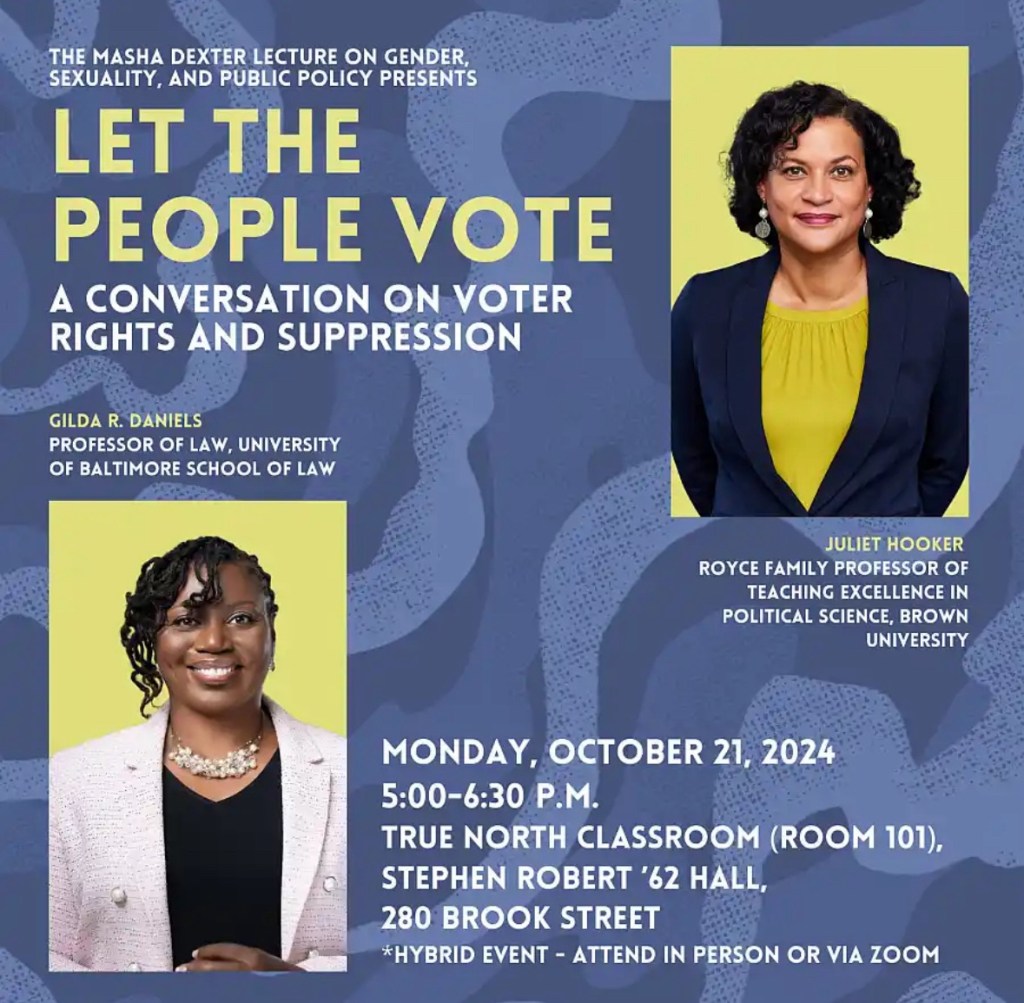
Let the People Vote: Fighting Back against Voter Suppression 

On October 21st, I will have the pleasure of speaking about voting rights and voter suppression at the annual Masha Dexter Lecture on Gender, Sexuality, and Public Policy at Brown University. I will be in conversation with Professor Juliet Hooker. You can register to attend this event virtually using this link

As I discuss in my book Uncounted, there is a long history of voter suppression targeting Black and Brown voters in this country. Voter suppression works in cycles, constantly adapting and finding new ways to hinder access for a growing population of people of color.

Voter suppression has only continued in recent years, enabled by the Supreme Court decision in Shelby County v. Holder that dismantled Section 5 of the Voting Rights Act. Recent examples of voter suppression include stricter voter ID requirements, meritless claims of rigged elections, and baseless accusations of voter fraud, among others.

We must stand up against voter suppression! Exercise your right to vote and organize against restrictive laws and practices that erode the very basis of American democracy – the right to vote! 

Know Before You Go: Absentee/Mail-In Voting

With less than one month to go before the November General Election, many voters are already participating in absentee voting. Absentee voting is also referred to as “mail-in voting” or “vote by mail”. This practice involves receiving your ballot by mail, and then returning it by mail or in person. 

All states offer some form of absentee voting. It is an important option that can make voting more accessible.

The requirements for absentee voting vary by state. Some states, such as Alabama, require voters to provide a “valid excuse” for not voting in person on Election Day in order to receive an absentee ballot. Other states, such as Virginia, allow anyone to request an absentee ballot, regardless of whether they are able to vote in person on Election Day. Still others, such as the District of Columbia, automatically mail an absentee ballot to every registered vote. We must continue to advocate for expansive absentee voting options in all states.  

To find out the rules and deadlines for absentee voting your state, you can visit https://www.vote.org/absentee-voting-rules/ or your state’s Board of Elections website. 

Early Voting Is Starting Soon!

Early voting for the November general election is beginning as early as next week in some states. The majority of Americans are eligible to vote early without an excuse. Early voting can fit into any schedule and is a great option to ensure that all citizens can participate in our democracy. 

The availability and dates for early voting vary by state. Below are the start dates for early voting in the states where it is provided. You can use the tool at https://www.vote411.org/search-by-topic to find more information about early voting in your state (just select your state and the topic “early voting”). As always, it’s best to double-check with your state for any recent changes to early voting. 

AlabamaNone
Alaska10/21/2024
Arizona10/9/2024
Arkansas10/21/2024
California10/7/2024
Colorado10/21/2024
Connecticut10/21/2024
District of Columbia10/28/2024
Delaware10/25/2024
Florida10/26/2024
Georgia10/15/2024
Hawaii10/22/2024
Idaho10/21/2024
Illinois9/26/2024
Indiana10/8/2024
Iowa10/16/2024
Kansas10/16/2024
Kentucky10/31/2024
Louisiana 10/18/2024
MaineVaries[1]
Maryland10/24/2024
Massachusetts10/19/2024
Michigan10/26/2024
Minnesota9/20/2024
MississippiNone
Missouri10/22/2024
Montana10/7/2024
Nebraska10/7/2024
Nevada10/19/2024
New HampshireNone
New Jersey10/26/2024
New Mexico10/8/2024
New York10/26/2024
North Carolina10/17/2024
North DakotaVaries
Ohio10/8/2024
Oklahoma10/30/2024
OregonVaries
PennsylvaniaVaries
Rhode Island10/16/2024
South Carolina10/21/2024
South Dakota9/20/2024
Tennessee10/16/2024
Texas10/21/2024
Utah10/22/2024
Vermont9/21/2024
Virginia9/20/2024
Washington10/18/2024
West Virginia10/23/2024
Wisconsin10/22/2024
Wyoming10/8/2024

Source: https://ballotpedia.org/Early_voting_dates,_2024

The Importance of Down-Ballot Voting

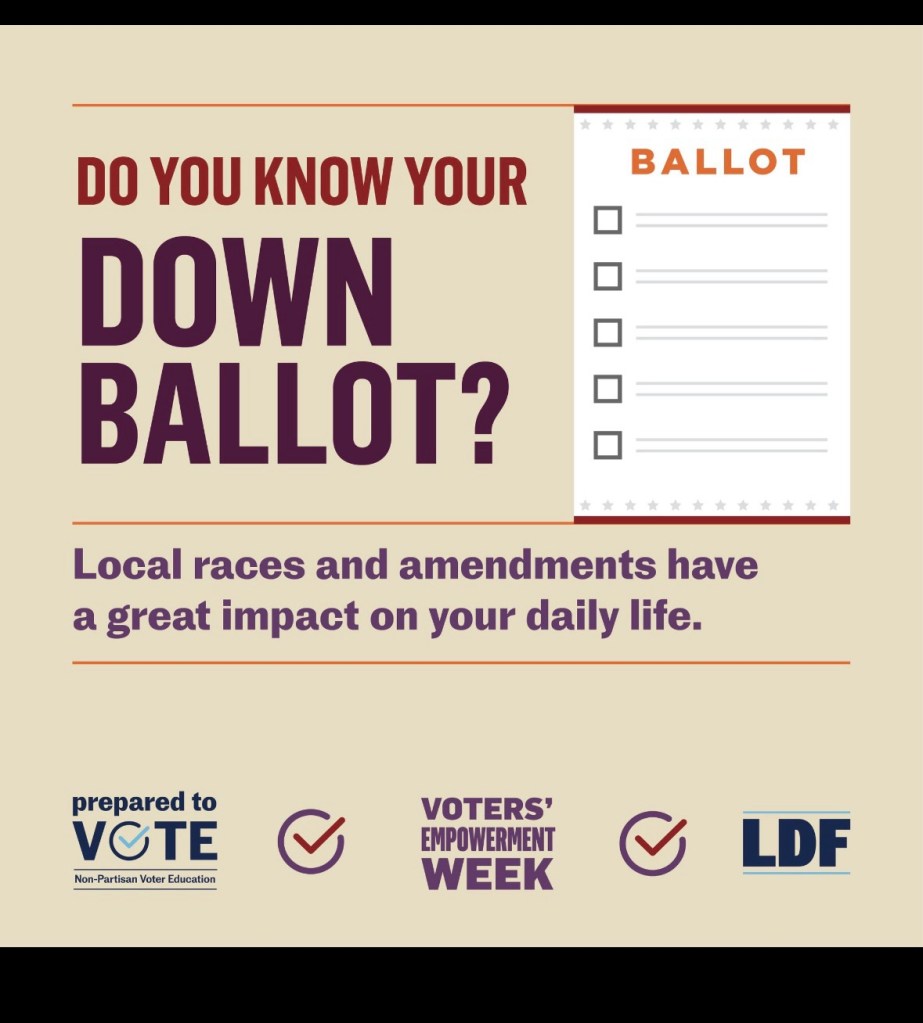
We all know that this is a presidential election year. However, it’s important to vote for every office and issue on the ballot, not just the president. In voting rights spaces, we refer to the practice of completing your entire ballot as “down-ballot” voting. 

Down-ballot voting especially impacts local elections. Local elections, in turn, impact our daily lives. For example, local governments play a significant role in everything from roads to schools to transportation to policing. Why give up the power to influence these important issues? 

In order to show up prepared to vote for every office and issue on your ballot, do your research before you arrive at the polls! Here are a few resources you can use to educate yourself on local candidates and issues:

  1. Review a sample ballot at Ballotpedia: https://ballotpedia.org/Main_Page
  2. Check your local news for information about candidates 
  3. Use the ballot guide mailed to you by local and state voting officials

Let’s use our voting power to its fullest extent! Defending democracy is 365/24/7. 

Stay Vigilant against Disinformation Campaigns

We need to talk about the disinformation campaigns attempting to influence the November election and their targeted interest in Black and Brown voters.   

Earlier this month, the DOJ charged two Russian state media employees in an attempt to push back against Russia’s efforts to influence our presidential election. Russian disinformation tactics have included fake websites designed to look like authentic U.S. news outlets and AI-generated social media profiles, among other methods. 

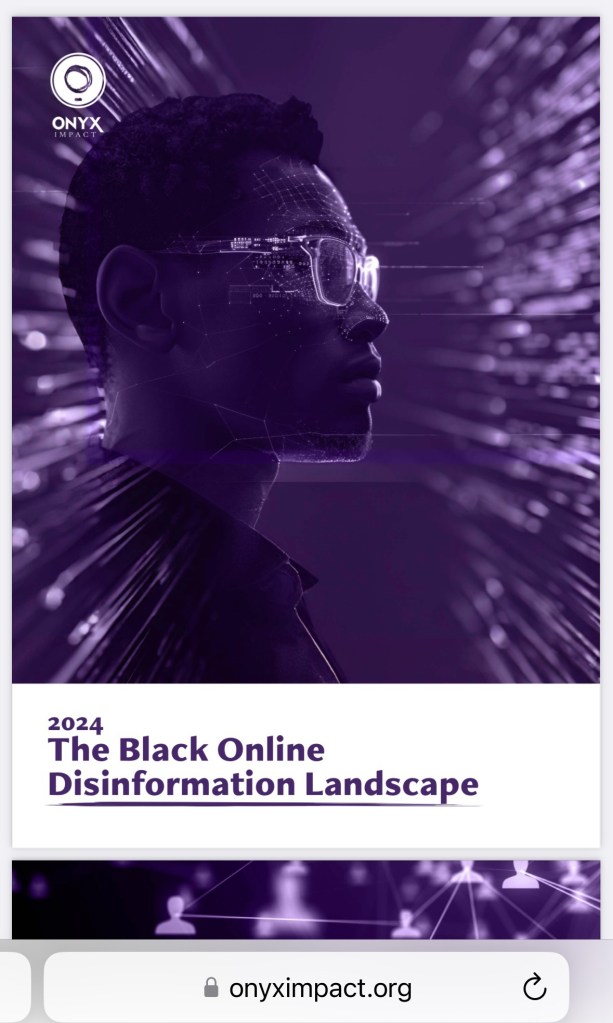
A disturbing amount of disinformation is aimed specifically at Black and Brown voters. A recent report by Onyx Impact found that more than 40 million Americans in Black online spaces may have been given disinformation about the upcoming election. This is not a new tactic. Disinformation was used during Reconstruction in efforts to prevent Black voters from participating in elections.  

Disinformation campaigns aim to undermine our democracy and diminish our political power. Here are a few steps you can take to prevent this:

We must stay vigilant! Defending democracy is 365/24/7. 

DMV Closures Hurting Voter Registration Numbers | KXNT 840 AM

A consequence of COVID-19 is widespread DMV closures and the inability to register to vote. You can read about Nevada’s experience here. DMVs and other voter registration options are sparse or non-existent in most states. Additionally, organizations that usually engage in voter registration activities are unable to do so in this state of emergency. #voterregistration #votingrights #COVID19

Queens Council Members Split Over Granting Non Citizens NYC Voting Rights | Jackson Heights Post

Considering expanding the vote to all residents of a locality regardless of citizenship status, read here.

Jan. 27, 2020 By Kristen Torres “The Queens delegation is split over a city bill that would grant green card holders and many other legal immigrants.”

Source: Queens Council Members Split Over Granting Non Citizens NYC Voting Rights | Jackson Heights Post